Pages

Showing posts sorted by date for query erie. Sort by relevance Show all posts

Tuesday, February 12, 2019

DeWitt Clinton's 250th birthday [updated]

Join me in celebrating at the Erie Canal Museum in Syracuse on Saturday, March 2 at 11 am. Also later that day at Buffalo Maritime Center. (Update: Buffalo at 4:30.)
UPDATE:


UPCOMING EVENT: Schenectady County Historical Society, April 13.

One more update:


"DeWitt Clinton's Sense of Time," Splice Today.

Saturday, March 17, 2018

In DeWitt's Footsteps

For info on my book, In DeWitt's Footsteps: Seeing History on the Erie Canal, see eriecanalbook.com. Or buy it on Amazon. Also, see its Twitter and FB pages.


Thursday, January 18, 2018

Review: David Frum's Trumpocracy

I read David Frum's new book Trumpocracy: The Corruption of the American Republic in just a couple of sittings, and highly recommend it to people across the political spectrum, including current Trump supporters, as it is a valuable, cogent analysis that will provoke thinking and rethinking.

First, some context and disclosure: David is a friend of mine. I was a regular contributor to his onetime website FrumForum; among the articles I wrote there were ones on early American history that turned out to be early stages of research for my book about DeWitt Clinton and the Erie Canal. I broadly share Frum's desire for, to quote a passage in Trumpocracy, "a conservatism that is culturally modern, economically inclusive, and environmentally responsible, that upholds markets at home and US leadership internationally." We have some differences, of course, one being my more favorable view of immigration (watching the Trump administration's actions in this area has firmed up this opinion). David remains a member of the Republican Party, whereas I switched to independent the day after Trump clinched the nomination.

A formidable strength of David's, manifest throughout Trumpocracy, is his capacity to follow arguments where they lead, regardless of whether the results are pleasing to any particular political faction. He is known as a "Never Trump" Republican, but unlike some such he has no illusion that all was well with the GOP before Trump came along. (By contrast, see this Jay Nordlinger piece about leaving a party that had been suddenly--inexplicably--disfigured by Trump.) Democrats eager to plunge into a book about Trump's authoritarianism may be discombobulated, early on, to read about how President Barack Obama stated that circumventing Congress on immigration was beyond the rightful powers of his office--and then did so anyway when that became politically expedient.

My statement above that I hope Trump supporters will read Trumpocracy is in earnest. In this era, we have become cynical about the ability of facts and logic to change minds, and I suspect we have gone too far in discounting such possibilities. There are, I imagine, some Trump-supporting Americans who will be alarmed at seeing evidence of the widening chasms between Trumpism's sales pitch and its reality: a nationalism determinedly oblivious to the machinations of hostile foreign governments; a populism intensely focused on benefitting wealthy donors and enriching those in power; a proclamation of American strength while weakening alliances and values that have been crucial to America's position in the world; a religiosity in defense of a man who pays blackmail to porn stars.

Readers of various political stripes may be surprised by the optimism of the book's final chapter. Frum notes some quite unintended benefits that Trump has brought to the American political scene, such as: a greater awareness of the importance of truth, precisely because the president is so grossly untruthful; on the left, a growing concern about national security, in contrast to a onetime dismissal of the idea that Russia is any kind of a threat; and for the right, an opportunity to look beyond stale ideological orthodoxy--albeit perhaps at the price of an impending political catastrophe.

In a telling anecdote, Frum recounts how an attendee viewing a panel discussion complained along these lines: "We can't stop Donald Trump by going soft. If we want to stop him, we have to imitate him." To which David answered: "But if you imitate him, you won't stop him. You'll only replace him." Trumpocracy is a powerful argument for a post-Trump era that truly leaves the man's legacy behind.


Tuesday, January 2, 2018

2018

Greetings. Blogging is only occasional at this site currently. Please see my Twitter feed, my book website and related Twitter feed, and the Amazon page for my book In DeWitt's Footsteps: Seeing History on the Erie Canal.

Friday, September 8, 2017

In DeWitt's Footsteps [updated]

My book In DeWitt's Footsteps: Seeing History on the Erie Canal has been published. Read more about it here, here and here. Buy it on Amazon here.


Update 10/8: A list of book-related events is here. And here's video of an appearance this weekend:


Friday, June 30, 2017

Erie Canal at 200: links

As July 4 is the 200th anniversary of the groundbreaking of the Erie Canal, a number of articles and posts have appeared lately about the canal's history and DeWitt Clinton. Some links are below. My book on the subject will be out later this year, mixing history with family history as DeWitt Clinton is a direct ancestor of my wife and son; and featuring extensive photos of what you see now as you travel the canal's historic and modern paths. More to come about the book in the next couple months.

News flash: Clinton Street was NOT named for Hillary Clinton (Chicago Sun Times)

200 Years on the Erie Canal (Commentary magazine)

200 Years Ago, Erie Canal Got Its Start as Just a ‘Ditch’ (NY Times)

New York's Erie Canal: How a 200-year-old ditch made the Empire State (NewYorkUpstate.com)

What Donald Trump said about the Erie Canal (Rochester Democrat and Chronicle)

Monday, January 30, 2017

Betraying our history

Recommended reading: "America Now Looks Like the Past, Not the Future," by Jeet Heer. Excerpt:
To judge by his speeches, notably an inaugural address that fear-mongered about “American carnage,” the president believes the country is in deep trouble and needs to get its own house in order. Trump is more interested in recovering past glories—the old days when “we’d win with wars” rather than now, when “we don’t win anymore”—than in creating a new tomorrow. It’s no surprise that some of the loudest complaints about Trump’s ban came from tech companies like Apple, Google, and Facebook that rely on the immigrants that Trump demonizes.
Me: I've spent the last few years researching the history of the Erie Canal, for a book I am now preparing to publish.


The Erie Canal is surely one of the things that made America great, and it would be easy to view it in terms of nostalgia. But looking back on its development I am struck most by how forward-looking the people involved were. The canal is where American technology really began, with surveyors turning themselves into a new profession of engineers in on-the-job training. The canal also helped immigrants become part of America, as they built it and traveled on it further into America.

America looking more like past than future is one of the deepest betrayals of our heritage that can be imagined. Those interested in recovering past glories should at least have some clue what they are.

Tuesday, January 26, 2016

Clinton mention

Hillary Clinton, campaigning in Iowa, took note of DeWitt Clinton (not a relation of hers):
“I did a little research,” Mrs. Clinton said at a town-hall-style event at Eagle Heights Elementary School in Clinton on Saturday. “Clinton County is named for DeWitt Clinton, the sixth governor of New York,” Mrs. Clinton continued. “He was the person who said, ‘We’re going to build a canal from the Hudson River down to Lake Erie all the way across New York.’ ”
Me: It was odd to see the subject of my in-progress book show up on the campaign trail. This political season has been a rather engrossing distraction. One thing I admire greatly about DeWitt Clinton is that, even though he was a professional politician, his interests outside politics were many, deep and varied.

Friday, May 1, 2015

Progress report on learning math online [updated and moved to top]

3/25/15: I've been studying math lately, as noted in the post below. I'm now in the 6th week of Prof. Keith Devlin's "Introduction to Mathematical Thinking," which runs either 8 or 10 weeks depending on whether you stop after the Basic Course or continue through the Extended Course. The latter is described in the course description as being particularly difficult:
Students who struggle with the Basic Course are likely to find the additional two weeks of the Extended Course extremely difficult, if not impossible. Note also that the final two weeks of the Extended Course are more intense than the Basic Course, being in part designed to give students a sense of the pace of a university-level course in pure mathematics. Moreover, in Week 10 there is a series of fairly tight deadlines you must meet, with 48 hour turnaround times. [Emphasis in the original.]
Me: We'll see how that goes, as I've been hoping to make it through the Extended Course and get the Statement of Accomplishment With Distinction that comes from passing it. I've found the course highly interesting and will have learned a great deal regardless of how far I get. The overall course emphasizes logic and proofs, and is designed to give a sense of how mathematicians think (in contradistinction to the emphasis on following instructions that characterizes much K-12 math). At times, I have struggled with the concepts, though my weekly test results have been generally decent (with one exception), with scores equivalent to about 87, 87, 41 (oops), 96 (comeback) and 86.

The course is not particularly oriented toward visual thinking, but I have found some visualization helps in grasping the concepts. Here is what I drew and wrote for a homework problem. [Added: SPOILER: Don't read the image first if you want to answer the question yourself.] The question was: "Prove or disprove the claim that there are integers m, n such that m2+mn+n2 is a perfect square." I drew and wrote the below, and posted it to a class discussion board (along with a question as to whether and to what extent "visual proofs" are acceptable):


A fellow student pointed out that my diagram doesn't match the algebraic expression m2+mn+n2, which is true. If I were to do it over, I'd leave one of the mn boxes out or cross-hatch it or something. My basic idea that the claim is verified by making n zero seems to have some merit.

Here is a report from someone who took the same course a couple of years ago. I agree with many of the sentiments expressed, including about finding the course very interesting and enjoyable, and also about this:
Assignments are not submitted for marking (but a helpful feedback video is made available in the next week in which Devlin explains how to answer a selection of the questions). In the first few weeks of the course Devlin puts a very prominent amount of emphasis on the need for all students to discuss the course with others in an informally established study group. In my case I chanced on and joined a Google Group called “Mathematical Thinking UK Discussion Group”. This initially had about 40 members. About seven were helpfully active in the first three weeks, but the study group has seemingly since ceased to function. So I am on my own: it feels a bit late in the day to try to find another study group, nor to attempt to breath life into this one.
Me: That mirrors my experience very closely, as I was part of a weekly Google Hangout study group, which started off very promising and then progressively wound down into nothingness. I gather the dissolution of such groups has a lot to do with people quitting the course (considerably more that, I suspect, than with people finding the course easy and deciding they don't need a study group). The statistics posted by the professor weekly show that, while a large number of people are enrolled (over 38,000, from all over the world), they vary in activity or lack thereof; and those who actually hand in the weekly test, or Problem Set, are a small and declining subgroup (under 1,500 at last count).

In any case, I've become a big fan of online courses, a remarkable and unprecedented resource (and one that for now at least is often free). Edward Frenkel, who did much to inspire my newly heightened interest in math, has an upcoming (and seemingly not too time-consuming) class, which I've signed up for as well. Whatever limits I encounter in my online education, it's clear to me that I've learned much already, and that this has been time well-spent.

The above was originally posted 3/25/15.

UPDATE 4/28/15: I've completed the course, including the extended course, and am now awaiting my Statement of Accomplishment With Distinction, which I believe I earned. Someone pathetically tried to disrupt the peer-review portion of the extended course by placing numerous bogus "zero" reviews, but this was detected and deleted. I am now on to "Introduction to Mathematical Philosophy," which looks to have many fascinating concepts but also be less time-consuming (a good thing, given my schedule, though it also means it will involve less hands-on learning, as this course, unlike the previous one, does not involve handing in weekly problem sets for grading).

UPDATE 5/1/15: My SOA With Distinction. I was one of 275 students to get one of these; another 991 earned an SOA for completion of the Basic Course.


A few additional thoughts before closing this post:

1. "The only way to really learn math is by doing it." This is something one hears now and then, and I can affirm it based on my experience in this course. If I had only listened to the professor's lectures or read his book Introduction to Mathematical Thinking, without actually trying to solve the (ungraded) assignments and (graded) problem sets myself, I would not have gotten nearly as much out of this course.
2. "You don't really understand something until you've taught it." Another bit of repeated wisdom that I find has validity. In evaluating other students' work and trying to explain things to them, I found I had to learn the material better than I would have just from handing in my own work.

3. My final grade was 98.5%, which is of course good but needs some context. The numerical grades are described by the professor as "akin to the points awarded in a video game: significant within the game, but only within the game." Under the scoring system, it is possible for students to get more than 100%, which then gets normalized to 100%. My grade was boosted by certain features of the scoring, such as that it includes only your highest score out of three "evaluation exercises" (evaluating proofs and seeing how close your score is to the professor's; I did great on the third one); in general, the grades are a marker of progress and persistence more than performance.

4. A substantial portion of this course is about language and communication; such as in converting between natural language and symbolic logic, and in assessing the clarity of proofs. When I signed up for "Introduction to Mathematical Thinking," I wondered if I might be going too far afield in spending valuable time on something unrelated to my financial journalism day job, Erie Canal book project and overall writing career. I'm pleased to find the course was plenty relevant to writing.

UPDATE: More here.


Sunday, January 4, 2015

Winter 2015

This is and will be a busy winter, with current projects including writing a book review involving nature and childhood, taking an online math-related course at Stanford, keeping up my column and editorial duties at Research magazine, and importantly, writing my Erie Canal/DeWitt Clinton book. Posting at this blog is going to be sporadic for some time to come. Thanks for stopping by.

Sunday, October 5, 2014

Clinton history travels

Here are my son DeWitt and my wife Brooke at Fort Montgomery, in upstate new York, today, watching a reenactment of the battle where their direct ancestor James Clinton and his brother George Clinton fought against their distant relative Henry Clinton. Grant Miller, manager of the Fort Montgomery State Historic Site, is narrating the action.

Fort Montgomery 10-5-14
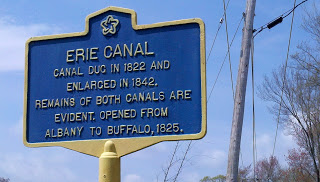
And back in August we visited the Syracuse area, where I continued my Erie Canal book research. Dan Ward, curator at the Erie Canal Museum, showed us around the museum as well as Camillus Erie Canal Park, which has impressive remnants of Clinton's Ditch as well as the Enlarged Canal. We also made a preliminary visit to the Chittenango Landing Canal Boat Museum.

DeWitt Clinton portrayal at Erie Canal Museum

Sign at Camillus Park
1842 Nine Mile Creek Aqueduct, restored in Camillus Park
Dry dock at Chittenango


Saturday, June 14, 2014

Research in Buffalo

A busy weekend of Erie Canal/Dewitt Clinton research. Here's a Buffalo News article about some of it.

UPDATE: As it appeared in the newspaper:


Monday, June 2, 2014

Blogging and more

This blog will probably be updated at a leisurely pace through the summer. Apologies to its small contingent of regular readers. I will be stepping up my Erie Canal/DeWitt Clinton book research, as well as writing for Research magazine (which bears neither credit nor blame for this blog) and other publications: I have a review upcoming in Financial History magazine, for example.

Regardless, I look forward to seeing the upcoming movie Earth to Echo, and certainly updates to this blog will include a review of that.

Thursday, December 19, 2013

Blog summary and hiatus

This blog needs a break, during which I can focus on other endeavors including my planned book about DeWitt Clinton and the Erie Canal. So, I'm going to plan on not posting anything before 2014. If something arises of great urgency, such that the world needs the Quicksilber perspective, I'll relax that policy. But it'll have to be something big, not polemical blather about Pajama Boy or the equivalent.

This blog has now been going on for just shy of six years. It has covered a wide, perhaps too wide, range of topics, and will resume its eclectic coverage early next year. For perplexed passersby who might arrive here via searches on topics ranging from Clinton Road New Jersey to the X Tax to "Obama whiskey" (whatever that was), I will explain that this is the blog of a politically minded centrist, a "deviationist apostle of the Frumian heresy" in one of my favorite self-descriptions, who works at a financial magazine, has spent some time in science journalism, studied economics and history and writes frequently on both and their intersection, and lives in northern New Jersey.

When I started this blog, I was a recent arrival in marriage and suburbia; since then I have also become a father, a baptized* Episcopalian and member of my church's vestry, a political moderate (and no longer a libertarian conservative or either part thereof); and more willing to reexamine ideological assumptions than I was in my younger decades. This blog has documented some of those interests and reexaminations. Thank you for stopping by, and special thanks to the friends, colleagues, ex-colleagues, ex-friends and interested strangers who've stopped by on a repeated basis, or at least more than once.

And below, an hour by car south of the Erie Canal, is the source of the Susquehanna River, taken on Memorial Day weekend 2013 before the canoe regatta named for Gen. James Clinton; the rock has a marker noting that Clinton's Dam was here. Here it was that a family history of watery projects began.

Otsego Lake at the source of the Susquehanna.
* - and confirmed

Tuesday, November 12, 2013

Along the Mohawk

Erie Canal/DeWitt Clinton research continues. Many thanks to Eric Hamilton of the Mohawk Towpath Scenic Byway for showing us around the Vischer Ferry area this weekend. (It was also good to attend the Hudson Mohawk Industrial Gateway's gala for 2013.)

Nicely done aerial photo-based map.
One of many historic markers.
Classical Greek Revival house in Vischer Ferry hamlet.

Wednesday, August 7, 2013

What can we learn from 19th century canals?

Here's one reason I find the Erie Canal interesting: the 19th century history of canal building contains elements that can unsettle both the left and right of the current day. On one hand, the private sector conspicuously failed to connect the Great Lakes to the Hudson River. On the other hand, the federal government declined to do it, so it was a state project. On a third hand, New York State built most of the Erie Canal by hiring private contractors to do the building. On one hand, this state project was a huge success. On the other hand, other states that imitated it encountered a great deal of failure.

It's a complex history that doesn't lend itself to easy slogans about government or the free market. Still, people try to employ it for their political ends. Here's a piece in the WSJ by Larry Schweikart and Burton Folsom on "Obama's False History of Public Investment." The piece has this subhead: "Entrepreneurs built our roads, rails and canals far better than government did." Then when you read the article, it contains a very brief overview of canal history:
America's 19th-century canal-building mania is now largely forgotten, but it is the granddaddy of misguided infrastructure-spending tales. Steamboats, first perfected by Robert Fulton in 1807, chugged along on all major rivers before states began using funds to build canals and harbors. Congress tried to get the federal government involved by passing a massive canal and road-building bill in 1817, but President James Madison vetoed it. New York responded by building the Erie Canal—a relatively rare success story. Most state-supported canals lost money, and Pennsylvania in 1857 and Ohio in 1861 finally sold their canal systems to private owners.
In Ohio, when the canals were privatized, one newspaper editor wrote: "Everyone who observes must have learned that private enterprise will execute a work with profit, when a government would sink dollars by the thousand." 
Me: The above is accurate as far as it goes, but it doesn't amount to "Entrepreneurs built our ... canals far better than government did." Canal building was mostly done by government, for better and worse. The financial troubles faced by many canals other than Erie, manifested in the Panic of 1837, spurred a turning away from government infrastructure for the rest of the 19th century, such that the railroads were built by the private sector (although government helped in various ways to make this happen). In the 20th century, the pendulum swung back toward government infrastructure projects, albeit with plenty of wobbling back and forth over the decades. It's also worth pointing out that what worked well in, say, 1825 may or may not be the best model for what should be done in 2013.

Thursday, July 18, 2013

Space travel window

From an article about, and interview with, Elon Musk:
He was influenced, he says, by Isaac Asimov's Foundation series, a science fiction saga in which a galactic empire falls and ushers in a dark age. "It's sort of a futuristic version of Gibbon's Decline and Fall of the Roman Empire. Let's say you were at the peak of the Roman empire, what would you do, what action could you take, to minimise decline?"

It takes me a moment to realise it's not a rhetorical question. Um, poison the barbarians' water supply, I joke. Musk smiles and shakes his head. The answer is in technology. "The lessons of history would suggest that civilisations move in cycles. You can track that back quite far – the Babylonians, the Sumerians, followed by the Egyptians, the Romans, China. We're obviously in a very upward cycle right now and hopefully that remains the case. But it may not. There could be some series of events that cause that technology level to decline. Given that this is the first time in 4.5bn years where it's been possible for humanity to extend life beyond Earth, it seems like we'd be wise to act while the window was open and not count on the fact it will be open a long time."
Me: As I've mentioned, I'm writing a book about DeWitt Clinton and the Erie Canal. And it seems to me there's an analogy between 19th century canal building and 21st century space travel: There's a window to do something, and that window will close at an unknown time. National borders and cultural diffusions that seem inevitable in retrospect were anything but; if the window had closed, something very different would have resulted.

Friday, June 28, 2013

Book notes: glamour, genius, history

Review copy requested: The Power of Glamour: Longing and the Art of Visual Persuasion, by Virginia Postrel. (Pub. date Nov. 2013).

Review copy received: Divine Fury: A History of Genius, by Darrin M. McMahon. (Pub. date Oct. 22, 2013.)

Current reading: Bond of Union: Building the Erie Canal and the American Empire, by Gerald T. Koeppel. This is an excellent history and valuable addition to my Erie Canal research.

Tuesday, June 25, 2013

Canal research - Cohoes

Erie Canal research continues. Many thanks to Ed Tremblay of the City of Cohoes and Tom Carroll and Michael Barrett of the Hudson Mohawk Industrial Gateway for arranging access to Locks 37 and 38 of the original canal, which are buried in an old utility tunnel and are the subject of an interpretive area now under construction aboveground.


Cohoes is doing an impressive job of making itself a destination for history-minded tourists and others. Just down the block from the Clinton's Ditch site is a lookout over the Cohoes Falls; circumventing it was a key purpose of the canal.

Wednesday, June 5, 2013

Keeping tabs on reform conservatism [updated]

There's been a lot written lately about "reform conservatism," such that even people who are interested in the subject might have trouble keeping up. Here are a few notes from me on recent developments and current trends:

1. David Frum has put his DailyBeast blog on indefinite hiatus while he focuses on family and personal matters. He will continue his weekly CNN column but, for the time being, cease being the prolific figure he's been on the punditry scene. I wish him well, look back fondly on my involvement with the earlier FrumForum, and fully expect he'll return to a highly active public role sooner or later.

One thing that was great about FrumForum was that it was informed by a common sensibility (in particular, a belief that the GOP and conservatism needed to renew themselves in some way) but also contained a considerable diversity of opinion on particular issues and priorities. How else could the site have had room for, say, both me and my friend John Guardiano, who is notably more conservative than I've ever been? (I will note, though, that one other person I knew through FrumForum later made a point of cutting his ties to me, and not explaining why, which suggests limits to that intellectual diversity.)

2. Ross Douthat recently itemized his idea of a conservative reform agenda. I was reasonably in tune with a fair amount of what's on the list, but was unpleasantly surprised to see that he explicitly excluded "a cap-and-trade bill, or any sweeping regulatory response to climate change," while citing the influence of Jim Manzi and linking to a piece by the latter rejecting a carbon tax. There's room for debate on what to do about climate change, but if the conservative reform answer is to do nothing, or to focus some limited effort on future technologies that may help someday, then there is a gaping political and policy weakness at the center of reform conservatism.

3. There's some fuzziness as to what constitutes reform conservatism such that some people frequently identified as reform conservatives disclaim that they are conservatives. This came up recently with regard to the fast-rising pundit Josh Barro, who describes himself as a "neoliberal" and adds: "But people might understand better if I just started saying 'moderate.'" I agree that "neoliberal" is a confusing label (all those free-market reforms outside the U.S. were also "neoliberal," for starters). For my part, I am happy enough with "moderate" or "centrist" and have stopped calling myself, as I did in years past, a "libertarian" or "libertarian conservative." But since such I'm-not-a-conservative admissions generate an enormous amount of crowing from the likes of adamant conservative non-reformer Erick Erickson, I would also like to point out that what counts as conservatism has changed again and again over the decades (see The Conservative Century: From Reaction to Revolution, by Gregory L. Schneider for background) so I can easily imagine a future in which, say, Josh Barro is considered a conservative and Erick Erickson is considered what he is: a suitable partner for Lou Dobbs in discussions of biology.

4. I'm not quite as politics-focused as some of the people discussed above. Career-wise, I've had oars in multiple streams over the years, including financial journalism, science journalism and the Erie Canal. Quicksilber can be expected to continue covering eclectic subject matter, and there are even plans in the works for an artistic collaboration involving alien life. Still, at a time when there is some contention over where and among whom "real" conservatism and "real" reform conservatism can be found (and some hypocrisy about that, as Conor Friedersdorf points out), I consider my wide range of interests an asset, as reform conservatism will need input from people of varied backgrounds. I expect to continue paying attention, and occasionally weigh in, on this overall subject in the future.

UPDATE 2:10PM: Here's a reform conservative manifesto at Forbes, by Pascal Emmanuel-Gobry, in which the environment and science figure not at all. Man, this movement needs to broaden its agenda.

UPDATE 6/7: Welcome TalkRadioSucks members.